How I found it
I nearly didn’t go to that sale. It had rained all morning, the listing said “garage and household, everything must go,” which usually means a lot of Tupperware, and by the time I pulled up it was after three and the good stuff was long gone. A guy was loading a dresser into a pickup. Somebody’s kid was selling lemonade from under a carport, and I bought one mostly out of guilt.
The garage was what was left. Card tables, a coffee can full of mismatched screws, about forty years of National Geographic tied up with twine. Under one of the tables there was a cardboard box with a strip of masking tape across the top and LAMP written on it in marker, in those very square capital letters older men used to use on everything in the workshop.
I don’t collect lamps. I opened it anyway, because I’ve been fooled by boxes before and I’ve learned that what’s written on the outside and what’s inside are only loosely related. Before I even had the flaps all the way open I could smell it.
Old radios have a smell, sort of warm dust and varnish with something faintly electrical underneath, and if you’ve spent any time around them you’d know it in the dark. Lamps don’t smell like that.
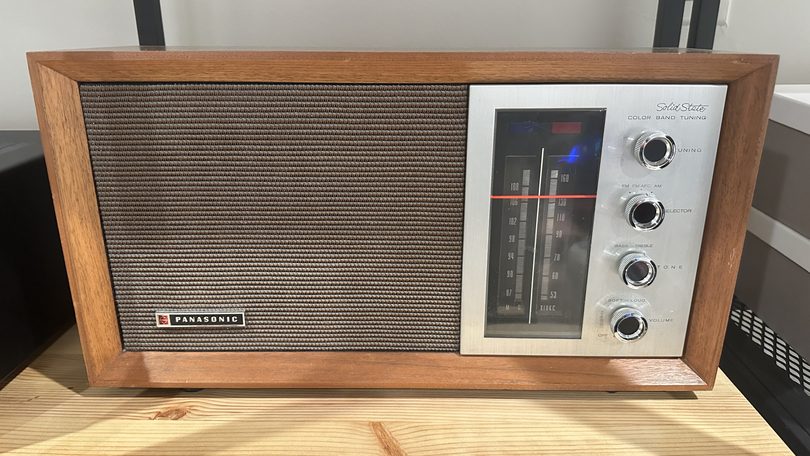
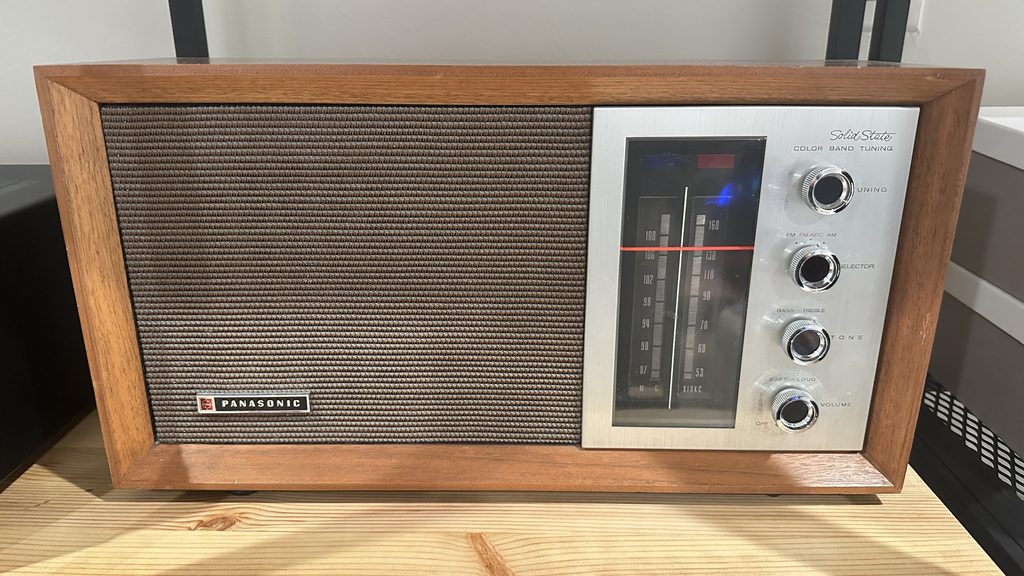
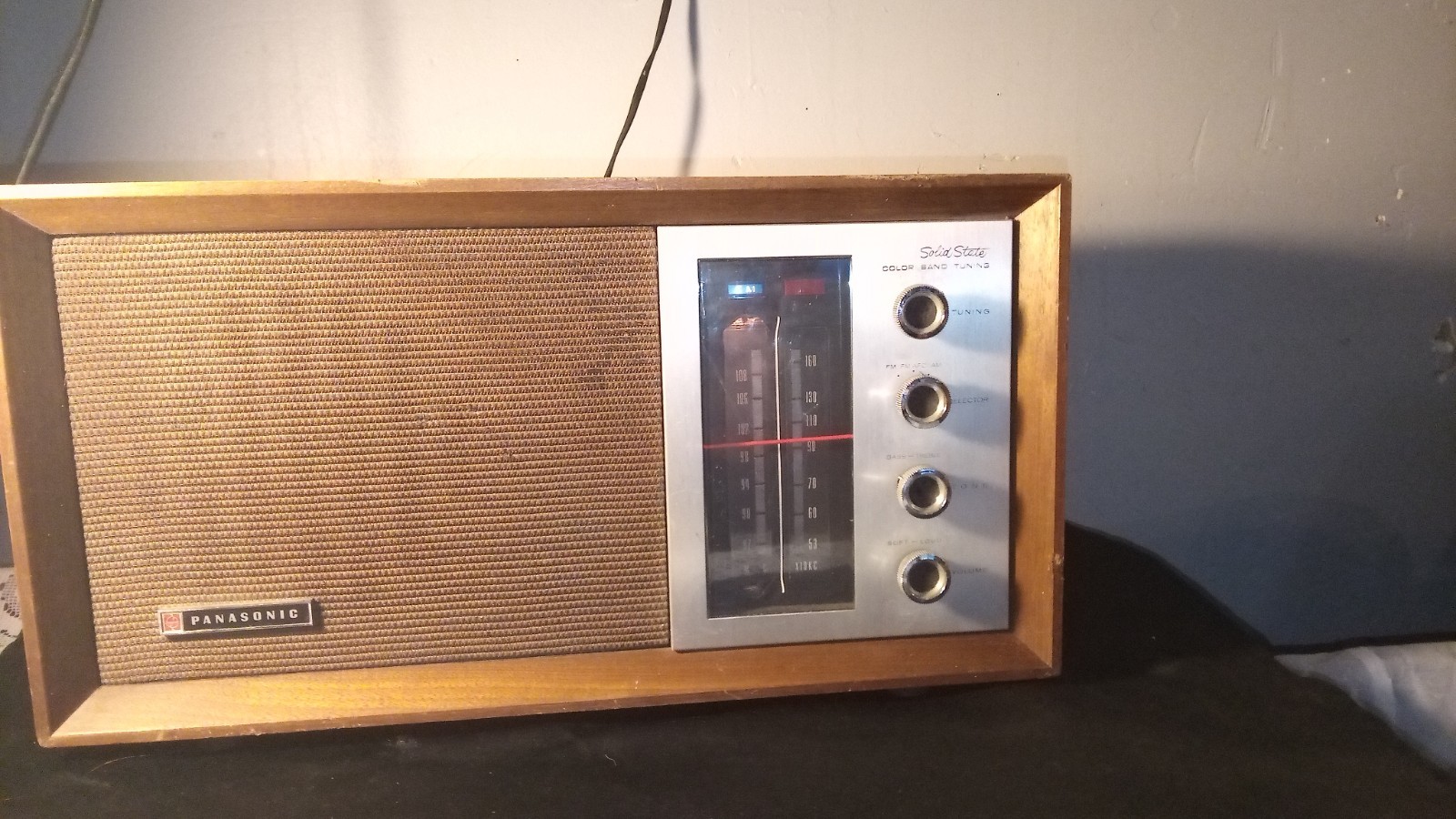
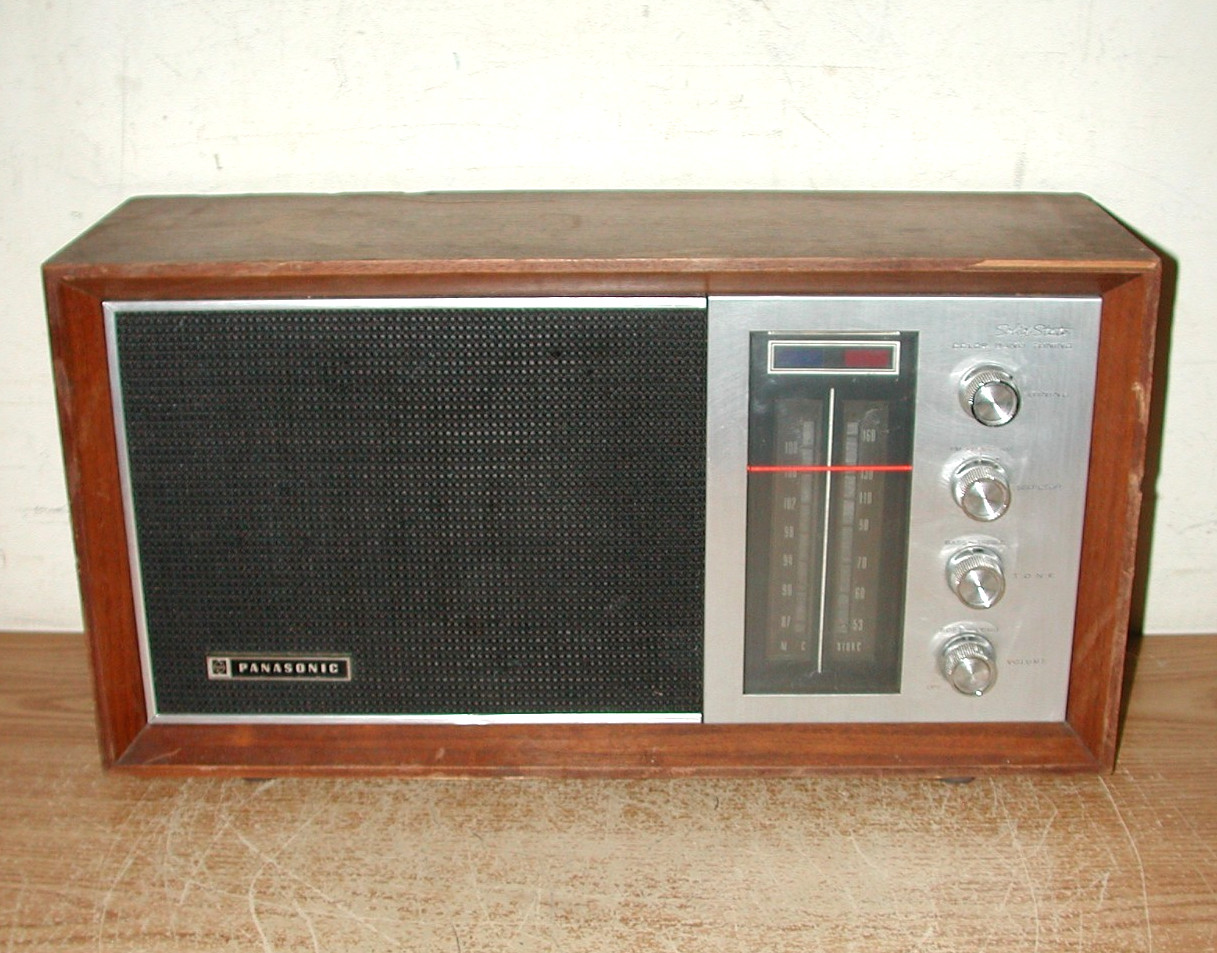
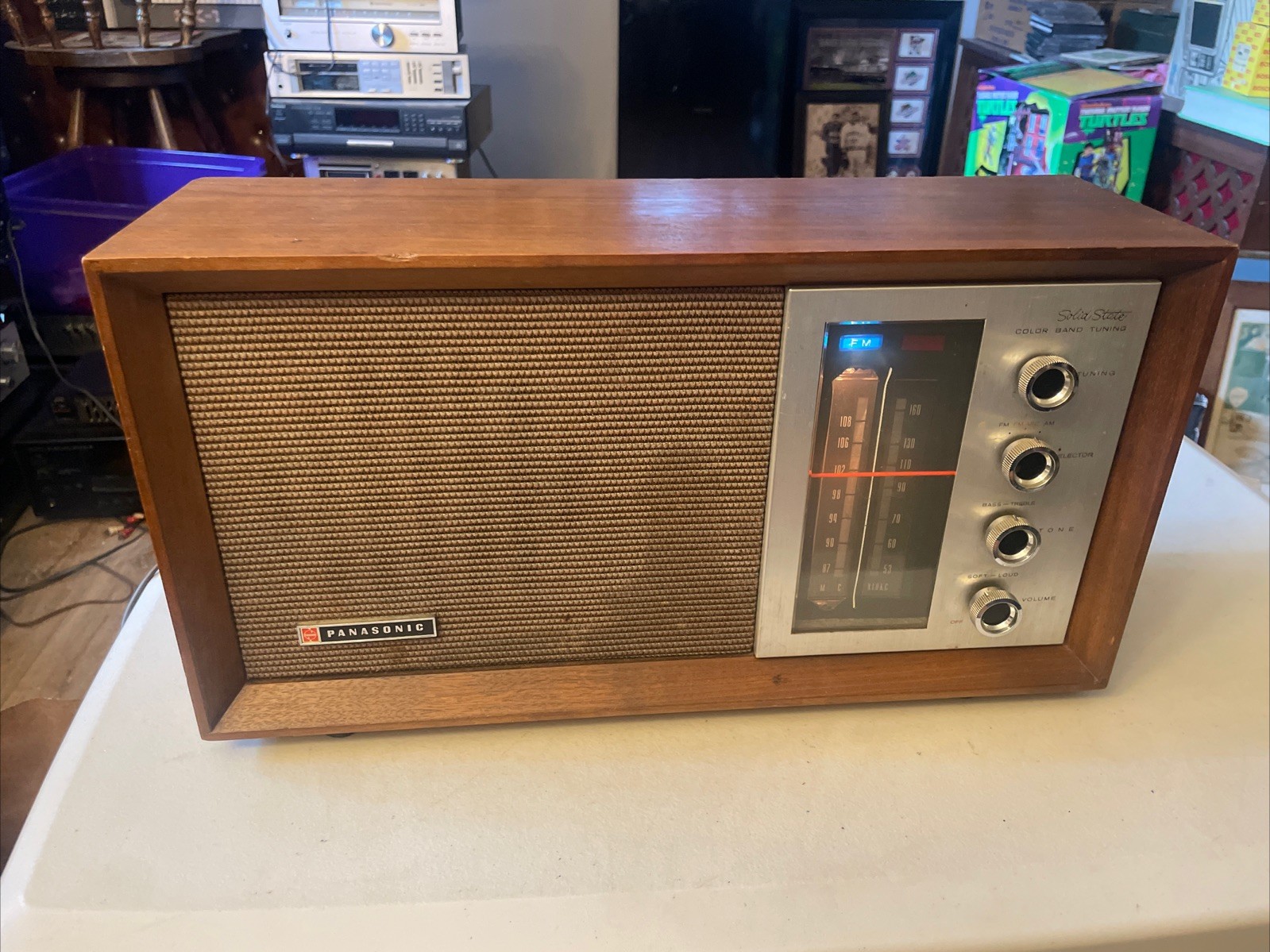
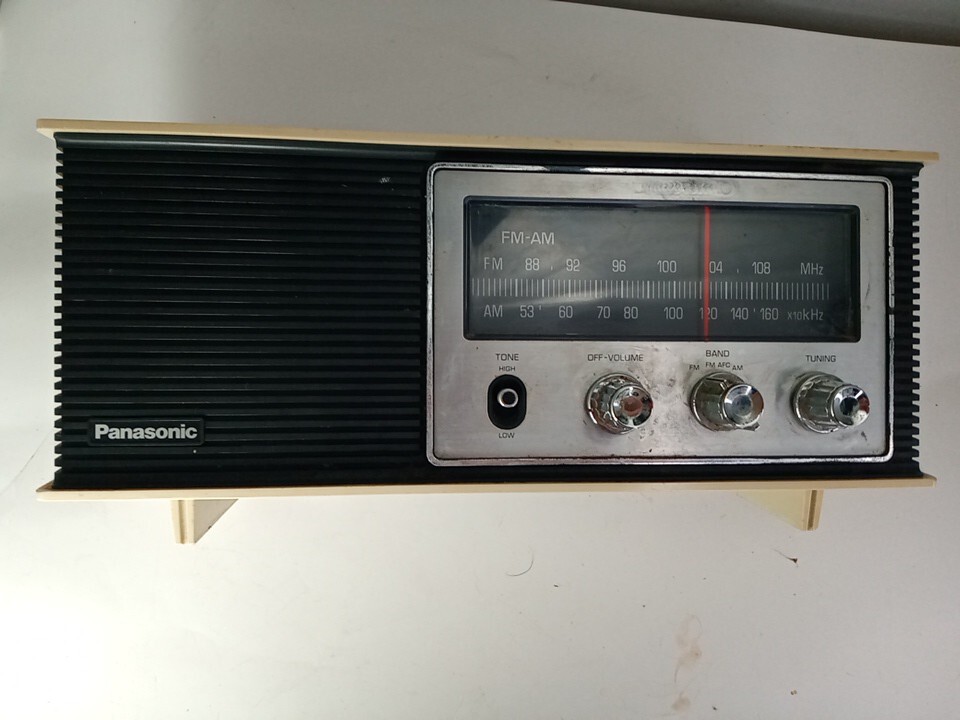
It was wrapped in a green bath towel. Walnut cabinet, about a foot and a half wide, brushed aluminum panel on the right side with four chrome knobs going down in a row. “Solid State” in script across the top, COLOR BAND TUNING underneath, and a little Panasonic badge in the corner of the grille cloth.
The woman running the sale came over while I was crouched there. She had a money apron on and a pencil stuck behind her ear. When she saw what I had she sort of smiled and said it was Walt’s, that it sat by the kitchen window for as long as she could remember. He’d turn it on first thing for the weather, then the farm report, and then whatever game was on, and he kept it in that box whenever they moved because he never threw out a good box in his life.
It was marked fifteen dollars. She let me have it for ten. “It’s just an old radio,” she said, which I’ve heard probably a hundred times at sales like this and I’ve never once agreed with.
I didn’t notice the writing on the bottom flap until I got it home and was breaking the box down. In pencil, same blocky letters: RADIO SHACK 49.95 XMAS 68. I figured it was a nice touch and not much more. It turned out to be exactly right, down to the penny, but I didn’t know that yet.
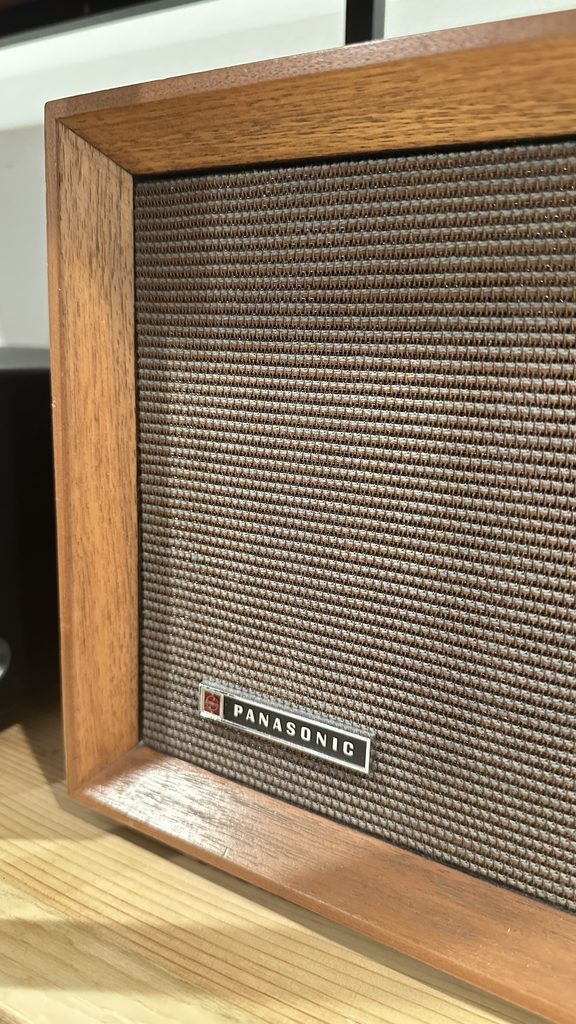
Vintage Panasonic RE-7257 for Sale on eBay




What the back panel says
Whenever I get a radio home, I turn it around before I do anything else. The front is styling. The back is where the manufacturer had to write down facts, and on a set this age those facts are surprisingly chatty.
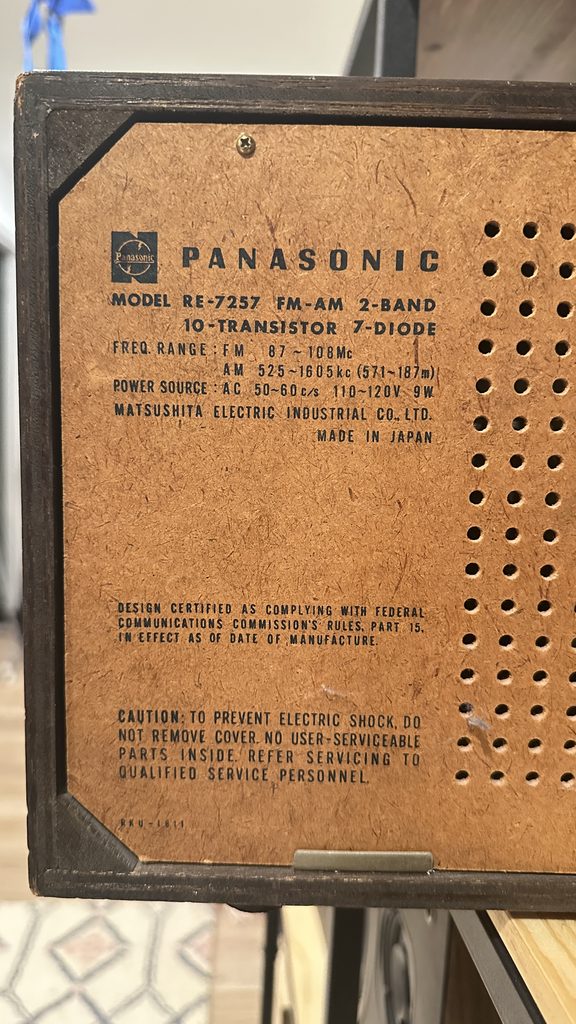
This one is printed straight onto the fiberboard: Model RE-7257, FM-AM 2-Band, 10-Transistor 7-Diode. FM 87 to 108 Mc, AM 525 to 1605 kc. AC 50-60 c/s, 110-120 volts, 9 watts. Matsushita Electric Industrial Co., Ltd., Made in Japan.
A couple of things on there are fun if you’re into this sort of thing (and if you’ve read this far, you probably are). The frequencies are in megacycles, kilocycles and cycles per second. “Hertz” was already the official unit by then, but American manufacturers and catalogs hung onto the old names for a few more years, and labels like this one are a good rough guide to age.
Then after the AM range there’s “571-187 m” in parentheses, which is the same band expressed as wavelength in meters. You almost never see that on sets made for the U.S. market. My guess is it’s left over from the same panel artwork being used on sets headed elsewhere.
And the maker is listed as Matsushita, not Panasonic. That’s not a mistake. Matsushita was the company, based in Osaka, and in Japan it sold things under the National name. National was already taken in the United States, so for this side of the Pacific they used Panasonic, a brand they’d come up with back in the 1950s. The company didn’t actually rename itself Panasonic until 2008, which surprises a lot of people.
The rest is the usual paperwork. FCC Part 15 certification, a UL mark over on the antenna panel, and the standard warning about electric shock and no user-serviceable parts inside, which I have never once obeyed. Down in the bottom corner there’s also a faint printed code, RKU-1611. I honestly don’t know what it refers to. Probably a part or print number for the panel itself. If anybody out there knows, I’d love to hear it.
On the front, “Solid State” gets its own fancy script lettering, and in 1968 that made sense as a selling point. A lot of households still had tube radios that took half a minute to warm up and got hot enough to warp a record if you left one on top. Transistor sets just came on.
Specs
For anyone who wants the numbers in one place, here’s what I wrote down.
| Spec | RE-7257 |
|---|---|
| Year | 1968 (in the 1968 Radio Shack catalog) |
| Circuit | Superheterodyne with a tuned RF stage |
| IF | 455 kHz AM, 10.7 MHz FM |
| Semiconductors | 10 transistors (2SC429, 2SC469 and others), 7 diodes |
| Speaker | 6.5 in. permanent magnet |
| Output | 2 W, 3 W max |
| Power | 110-120 V AC, 9 W |
| Cabinet | Walnut, about 17.4 x 9.7 x 5.5 in. |
| Weight | 8 lb 10 oz |
| Price new | $49.95 |
The RF stage is the one line in there I’d point out to another collector. It’s an extra amplifier stage ahead of the mixer, and a lot of table radios in this price range left it out to save money. Having it means the set pulls in weaker stations better and you get fewer stations bleeding into each other. Panasonic didn’t make a big deal of it in the advertising as far as I can tell, but you notice it when you tune around at night.
Radio Shack, page 98
So, about that pencil note. When I looked the model up on Radiomuseum.org, the entry says the RE-7257 was in the 1968 Radio Shack catalog on page 98, under Radio Shack’s own catalog number 12-1197, at $49.95. I read that twice. Walt’s box had the store, the price and the year, and all three checked out. I’ve had plenty of “family history” fall apart the minute I looked into it, so this one made my evening.
The Radio Shack connection is interesting in its own right. In the late sixties the chain was still pretty new under Charles Tandy’s ownership, and it was busy building up its own Realistic brand. Radios got catalog numbers starting with 12. A Realistic walnut clock radio in the 1967 catalog, for example, was 12-1134. So this Panasonic was sitting in the same catalog with a number from the same series as Radio Shack’s house-brand sets. Panasonic hadn’t been selling in America all that long at that point, and I suspect being stocked like that was a pretty good deal for them.
Fifty dollars was real money in 1968, too. An online inflation calculator puts it at around $480 today. People didn’t grab a radio like this off a rack on the way out. You’d save up for it, or you’d get one for Christmas, which apparently is what happened in Walt’s case.
Where else it turns up
Sams covered it in their Photofact service series in October 1969, Set 1054, Folder 5. For readers who never spent time behind a repair counter, Sams folders were what every radio and TV shop kept in filing cabinets: schematic, parts list, alignment procedure, voltages. They tended to cover sets that were selling in decent numbers, so having a folder tells you a fair number of these were out there.
Radiomuseum also lists an RE-7257C. Panasonic usually used the C suffix for Canadian versions around this time, so I’d assume that’s what it is, though I haven’t seen one in person.
There are some relatives worth knowing about. The RE-7487 came out in 1969 with the same transistor count and the same 2SC429s, and the RE-7259 from around the mid-seventies carried on with the walnut and aluminum look. If you have any of these, Jeff Miller’s write-up on his RE-7259 is a great read. He spent a month and fifteen dollars on it and documented every lamp.
Color Band Tuning, the dial, and the knobs
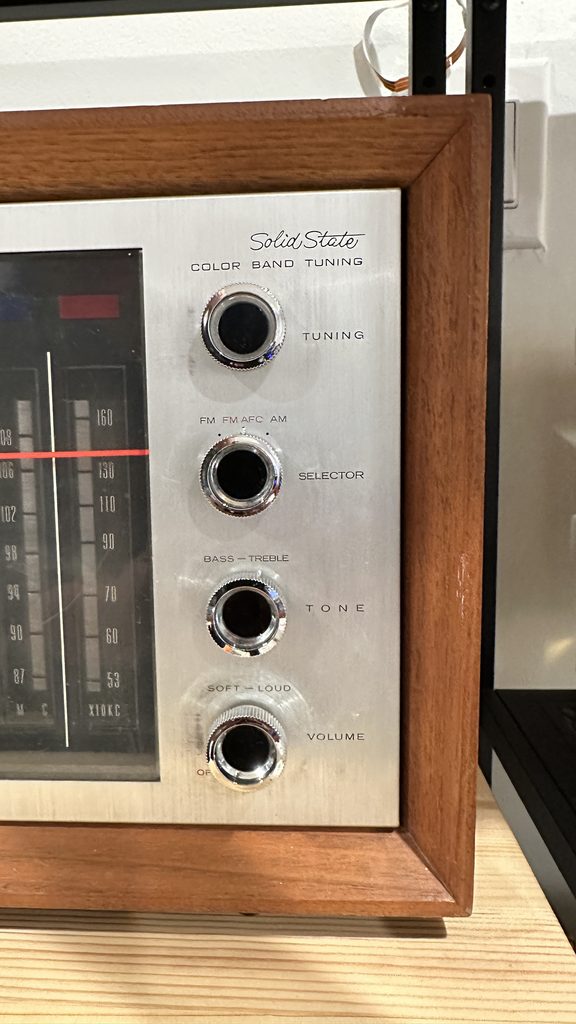
I assumed “Color Band Tuning” was just a phrase somebody in the marketing department liked the sound of. It actually describes something on the radio. At the top of the dial window there are two little colored rectangles, a blue one over the FM scale and a red one over the AM scale, and whichever band you’ve selected lights up. So you can see from across the room which band it’s on.
On the later RE-7259, Jeff Miller found those are lit by small screw-in bulbs behind colored lenses, and I’d bet the 7257 works the same way, though I haven’t had the chassis out of mine yet to check.
The dial is the other thing I like about this set. Most table radios from the period have a long horizontal dial with the pointer moving left and right. On this one the two scales run up and down, side by side, FM on the left from 87 to 108 and AM on the right from 53 to 160, and the pointer is a thin red line that rides up and down across both of them.
The AM numbers are marked “x10 kc,” so 53 is 530 and 160 is 1600. I’m sure it was done partly to fit everything into a narrow panel, but it also lines up nicely with the column of knobs next to it and gives the whole front a tall, tidy look.
The knobs, top to bottom, are tuning, selector, tone and volume. Tuning is the big one and has a nice smooth weight to it. The selector has three positions: FM, FM AFC and AM, with the AFC position printed in red. AFC is automatic frequency control, which keeps the FM side locked onto a station so it doesn’t wander off as the set warms up. That was a real issue with early transistor FM.
My routine is to tune the station on plain FM and then click over to AFC. The tone control is a single knob that goes from bass to treble, and the volume knob doubles as the on/off switch, with a small red OFF printed just under it. That little red word is one of my favorite details on the whole radio, for some reason.
The cabinet is solid walnut on the frame with a wide mitered front edge, almost like a picture frame around the grille. The grille cloth looks plain brown from a few feet away, but up close it’s a tight weave of brown and gray threads.
The badge in the lower left corner has a small red logo square and PANASONIC in spaced-out letters. Nobody was trying very hard to make it “mid-century modern.” It was just how good radios looked in 1968.
The antenna panel
On the back there’s a small cutout labeled FM ANT with two screw terminals, one red and one green, and a diagram printed next to it. From the factory it’s wired to the internal FM antenna. If you’re out in the country where the signal’s weak, the diagram shows you how to move the wire over and hook up an outdoor antenna instead, the old T-shaped 300 ohm kind everybody had back then. AM uses a ferrite rod antenna inside the cabinet. For a man who listened to the traffic report every morning, that FM terminal was probably more useful than it looks.
Cleaning it up
I didn’t plug it in at the sale, and I don’t ever do that with an old radio, even when the seller offers. If it’s been sitting in a box for years, the first power-up should happen on my bench with a dim-bulb tester in line, so if something inside has shorted the bulb lights up bright and takes the hit instead of the radio. This one made the bulb glow and then settle down, which is what you want to see. A few seconds later there was hiss, and then a station.
There wasn’t much wrong with it. The volume control crackled when I turned it, which is just dirt in the pot after fifty-odd years, and a little contact cleaner and a couple dozen turns back and forth took care of it. I pulled the knobs off and washed them in the sink with dish soap and a stiff nail brush.
The walnut was dry, so I cleaned it lightly and rubbed in a few coats of a wax and oil conditioner. I don’t refinish original cabinets unless they’re in really bad shape. The wear on this one is from Walt’s kitchen and I’d rather leave it.
The electrolytic capacitors are the part I’ll get to eventually. On a solid-state set from the late sixties they’re the thing most likely to go, and the usual signs are hum, fading, or the sound getting rough when you turn it up. Mine sounds fine for now, so it’s on the list and not at the top of it.
I should add that this plugs into the wall, and the inside of any AC radio can give you a nasty shock. If you haven’t worked on one before, take it to somebody who has. There are still people who fix these, and some of them still have their old Sams folders.
What it sounds like
Honestly, better than I expected. The 6.5 inch speaker in a wood cabinet gives voices some real body, a lot more than the little plastic portables from the same years. FM on the AFC setting is steady and clean. It’s mono, so there’s no stereo spread, but for a ball game or the news while I’m cooking it’s just right. It sounds like somebody’s kitchen in 1969, and I mean that in a good way.
If you’re looking for one
These aren’t rare, so you can afford to pass on a rough one and wait. Things I’d check:
- Run the tuning knob all the way up and down. The red pointer should move the full length of both scales without slipping or sticking. A bad dial cord can be restrung, but it’s fiddly work.
- Switch between FM and AM and make sure both the blue and red windows light. A dark one is usually just a bulb.
- Look at the corners and bottom edges of the cabinet for chipped or lifting veneer.
- Make sure all four knobs match. Replacements from other sets show up a lot.
- Turn it around and check that the back panel is there and readable.
Prices are all over the place. At estate sales and thrift stores I’ve seen them go for $10 to $30, and working ones online tend to sell somewhere between a few tens of dollars and about a hundred. Shops that sell mid-century furniture and décor ask more. One dealer has a restored 1968 Panasonic AM/FM table radio listed at $395, although what something’s listed at and what it sells for can be pretty different numbers. My advice is to buy a working one if you can, and pick the one you like looking at.
Where it is now
It’s on the second shelf in my workroom, next to a pile of records I keep meaning to sort, and I put it on most mornings while the coffee’s going. Weather first, out of respect.
I do think about how close it came to the dumpster. If I’d decided the rain wasn’t worth it, or skipped the garage, or believed the word on the box, somebody would have tossed it with the rest of the leftovers that evening. That’s how most of these go. Not dramatically, just at the end of a long day when nobody wants to haul one more thing.
What I ended up with was a little more than a radio, though I know that sounds corny. I got a Christmas present that somebody picked out of a Radio Shack catalog in 1968, and a man’s whole morning routine for about fifty years, and a pencil note that turned out to be accurate to the penny. I can’t really put a price on that, but ten dollars seems low.
If you’ve got one of these, or you remember one sitting on somebody’s counter, I’d like to hear about it in the comments.

Leave a Comment